Job Aid: Special Provisions
Special Provision Request Job Aid
This job aid describes the process agencies should use to submit requests for special provisions.
Agencies need to request special provisions to be included in the Governor’s Recommended Budget. OSBM has developed a special provision form to submit with each requested provision. The form is available in the job aids on the OSBM website.
When is a Special Provision Needed?
Special provisions are not needed with most budget requests. Generally, if the proposal is complex or you need specific authorization to undertake the request, then you probably need a special provision. A special provision is typically required to:
- Change program scope;
- Establish a new or pilot program not authorized within an agency’s existing authority;
- Eliminate programs defined in Session Law or General Statute;
- Change statutory requirements, including reporting requirements;
- Amend Session Laws or General Statute, such as adding definitions, making technical corrections, policy changes, repeals, etc.;
- Notwithstand existing statute; or
- Clarify a program’s purpose or criteria.
A Special Provision is not needed when:
- Expanding or reducing the budget of an existing program;
- Authority is already available for a program;
- The program can be described adequately in the “Snappy”; or
- The purpose of the program is apparent in the appropriation.
Agencies should have their General Counsel review all provisions before submitting draft language and special provision forms.
Completing the Special Provision Form
The special provision form summarizes the requested provision. A Special Provision Form must be submitted for each requested special provision. Agencies should submit their Special Provision forms by March 4, 2026. Hurricane Helene provisions must be submitted in their final form by February 4, 2026.
The form contains several questions:
- Type of Request:
- Boilerplate: A provision that is needed at the start of each biennium.
- Reporting Change: Changes a reporting date, report details, submitting or receiving entity or repeals or establishes a reporting requirement.
- Required for Change Request: A provision that authorizes an activity for which funding is requested.
- Study
- Other
- Technical Correction/ Change
- Has the Agency’s General Counsel reviewed the request?
- This is an important step; OSBM is not your agency’s legal counsel and recommends that all proposed provisions be vetted internally before being submitted.
- Has the provision been requested in the past? If so, when was it last requested?
- Does the provision have a fiscal impact on the requesting state agency, other state agency, or a public or private entity? If so, describe that impact.
- Brief Provision Description: Why is the provision needed? What is the history of the need for this provision?
- Are any stakeholders affect by the provision? If so, please list or describe the stakeholders affected and the effect on those stakeholders.
Drafting Special Provisions
Agencies should submit all final language by March 30, 2026. Hurricane Helene provisions must be submitted in their final form by February 4, 2026.
Considerations when Drafting Special Provisions
Please consider the following when drafting special provisions:
- Assess whether using General Statute vs. Session Law is most appropriate.
Comparison of General Statute vs. Session Law General Statute Session Law Does not expire (generally); Remains effective beyond the current General Assembly Session Expires at the end of the Session of the General Assembly (generally) Use for programs and policies that are intended to be long-lived and ongoing Items that are intended to be one time Amends Statute - Certain Session Laws need to be repeated in the next biennial budget. Many agencies have provisions that are included in the budget the biennium’s first year that authorize certain activities for the biennium and are repeated biennium after biennium. Review the budget for these “boilerplate” provisions and submit any that need to be repeated.
- Pay attention to the use of May vs. Shall: May is permissive; Shall is obligatory. If the provision uses “may” language such as “the Agency may do…,” consider if the provision is needed.
- Definitions.
- Define terms that are otherwise not defined in Statute.
- When defining terms, check existing statutes to avoid conflicting definitions.
- It is appropriate to refer to existing statutory definitions when defining terms.

- Avoid double appropriation language. Agency provisions do not appropriate funds and should not state “there is appropriated…”. All funds are appropriated at the front of the bill.
- Be specific. Provisions should:
- Include effective dates if different than the budget effective date (July 1).
- Include specific reporting dates and entities. Be clear about who reports, to whom, and on what date. Avoid “quarterly” or “annually”; set a specific date.
- Avoid “notwithstanding any other provision of law.” Notwithstand only the statute or session law that relates to the provision.
- However -- do not be overly prescriptive in program requirements. Consider alternative perspectives and unintended consequences of recommended language.
Formatting Special Provision
Special provision formatting is very important but often confusing. The following tips should clarify many special provision formatting issues:
“Redlining”
The General Assembly uses underlining and strike-through, aka Redlining, when changing existing General Statute and Session Laws. Any requested provision that changes existing General Statute or Session Laws should be “redlined” as follows:
- Use Track Changes. All existing laws should be edited using track changes. DO NOT use Microsoft Word’s underline and strike-through font formatting options.
New provisions that do not amend existing law should not include any track changes or special formatting as there is no language being changed. - Never redline a portion of a word or only punctuation:
Examples of incorrect and correct redlining of portions of words or punctuation Incorrect Correct sStatestateStateOSBM. OSBMOSBM. - Always use “reads as rewritten” when changing existing statute or session law.

Other Technical Considerations
- Definitions: Always put definitions in alphabetical order. Do not renumber existing lists, use alphanumeric to insert a new definition in a list.
- Ellipses: Provide succinct way to bring in a statute when more than one of the provisions are being changed or when a list is being amended in multiple places.
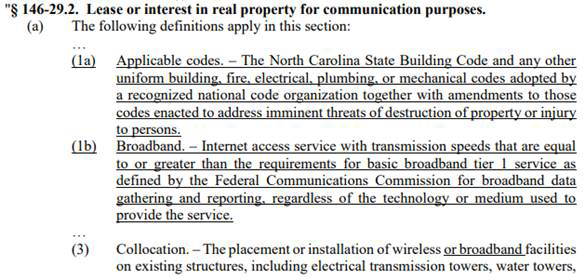
- Effective Dates: Include only if different than budget bill effective date (July 1).
- Numbering & Lettering of Statutory Provisions:
- Never reuse repealed statutory sections, subsections, subdivisions, etc.
- As with definitions, do not renumber existing statutes. Use alphanumeric characters.
- Numbers: Spell out numbers zero through nine; use numerals for numbers 10 or greater.
- Miscellaneous:
- Always remove history notes at the end of statutes.
- Italicize lower-case Ls (l not l) when used as a subsection of a statute or section.