
FY2026-27 Budget Rec Highlight Employees
Supporting State Employees
Recommendation
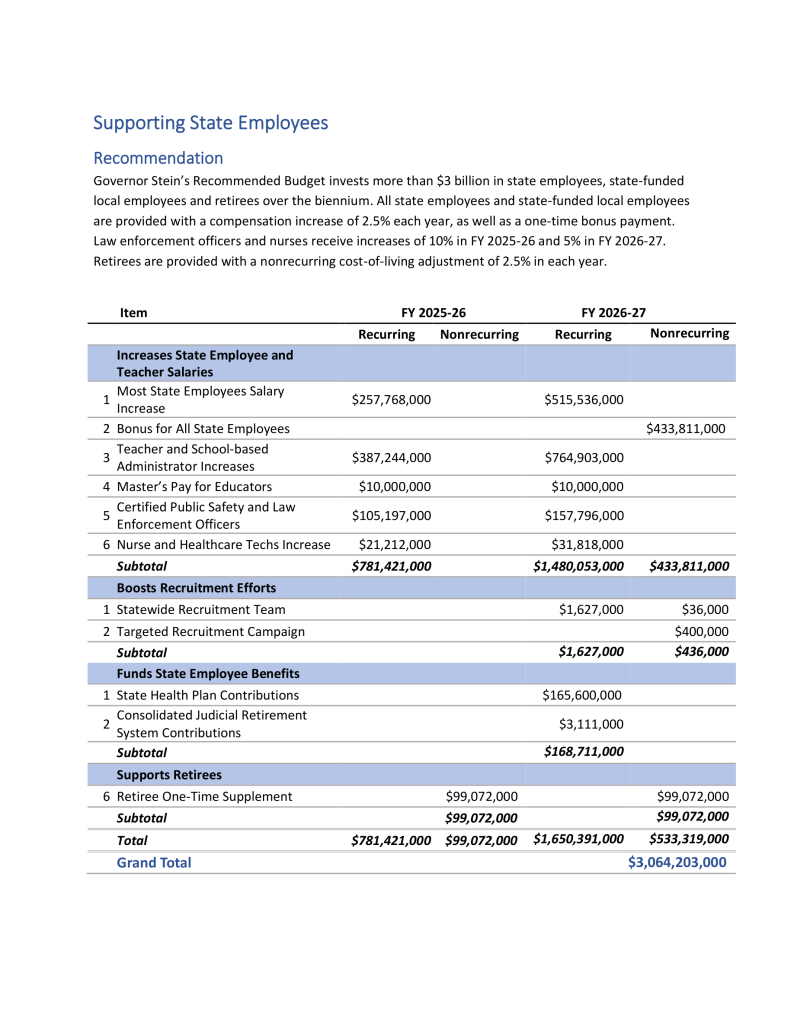
Governor Stein’s Recommended Budget invests more than $3 billion in state employees, state-funded local employees and retirees over the biennium. All state employees and state-funded local employees are provided with a compensation increase of 2.5% each year, as well as a one-time bonus payment. Law enforcement officers and nurses receive increases of 10% in FY 2025-26 and 5% in FY 2026-27. Retirees are provided with a nonrecurring cost-of-living adjustment of 2.5% in each year.
| Item | FY 2025-26 Recurring | FY 2025-26 Nonrecurring | FY 2026-27 Recurring | FY 2026-27 Nonrecurring |
|---|---|---|---|---|
| Increases State Employee and Teacher Salaries | ||||
| 1 Most State Employees Salary Increase | $257,768,000 | $515,536,000 | ||
| 2 Bonus for All State Employees | $433,811,000 | |||
| 3 Teacher and School-based Administrator Increases | $387,244,000 | $764,903,000 | ||
| 4 Master’s Pay for Educators | $10,000,000 | $10,000,000 | ||
| 5 Certified Public Safety and Law Enforcement Officers | $105,197,000 | $157,796,000 | ||
| 6 Nurse and Healthcare Techs Increase | $21,212,000 | $31,818,000 | ||
| Subtotal | $781,421,000 | $1,480,053,000 | $433,811,000 | |
| Boosts Recruitment Efforts | ||||
| 1 Statewide Recruitment Team | $1,627,000 | $36,000 | ||
| 2 Targeted Recruitment Campaign | $400,000 | |||
| Subtotal | $1,627,000 | $436,000 | ||
| Funds State Employee Benefits | ||||
| 1 State Health Plan Contributions | $165,600,000 | |||
| 2 Consolidated Judicial Retirement System Contributions | $3,111,000 | |||
| Subtotal | $168,711,000 | |||
| Supports Retirees | ||||
| 6 Retiree One-Time Supplement | $99,072,000 | $99,072,000 | ||
| Subtotal | $99,072,000 | $99,072,000 | ||
| Total | $781,421,000 | $99,072,000 | $1,650,391,000 | $533,319,000 |
| Grand Total | $3,064,203,000 |
Statement of Need
North Carolina state government faces a highly competitive job market, leading to high turnover and difficulty finding qualified candidates. A major challenge to hiring and retaining the state’s workforce is low wages and decreasing purchasing power as prices outstrip legislative increases. The state also has more employees reaching retirement age than ever before, further increasing the need to attract a younger workforce into joining government service.
- The cost of goods and services has increased by 2.9% in calendar year 2024 and 2.6% in calendar year 2025. State employees have not received a raise since July 1, 2024.1
- For calendar year 2025, the turnover rate for first year state employees was 33.7%. The total turnover rate for state agencies was 13.3%.
- The hiring rate, which describes the number of monthly hires as a percent of total employment, for state and local government employment was 1.3% in December 2025; the private sector hiring rate was 3.7%.2
- As of December 2025, 8.7% of agency employees are eligible to retire with full, unreduced benefits. More than a quarter of agency employees will be eligible to retire with full, unreduced benefits in five years. The average age of a North Carolina state government employee is 46, compared to 43 for employees in the national workforce.3
- Average teacher pay in North Carolina ranks 43rd in the nation, lower than all our neighboring states, and North Carolina teachers earn more than 25% less than other college graduates in comparable fields.4,5
- North Carolina struggles to keep effective educators and recruit new ones, and teacher turnover is nearly 10%, with starting teacher attrition increasing by more than 50% in the past five years.6
- With no raise since July 1, 2024, state law enforcement salaries for all types of officers rank among the lowest nationally, highlighting the need to restore competitiveness.
- North Carolina is currently 49th in the nation for starting correctional officer and State Highway Patrol (SHP) trooper salaries.7,8
- North Carolina currently has the eighth-worst nursing shortage in the nation and is projected to rank second-worst by 2038.9
Recommendation Detail
Compensation Increase for Most State-supported Employees
North Carolina’s ability to deliver strong, reliable public services depends on a stable, well-supported workforce. Governor Stein’s Recommended Budget makes strategic, long-term investments to strengthen recruitment, retention, and workplace stability across state government. These investments ensure that state employees—from teachers and health care professionals to correctional officers and front-line public servants—have the resources, compensation, and support needed to continue serving communities effectively.
The budget provides a guaranteed 2.5% across-the-board compensation increase for all state-funded employees in each year of this biennium, helping workers keep pace with rising costs and improving the state’s ability to compete for talent in a tight labor market. Bonuses of $1,500 for employees earning $75,000 or less and $1,000 for those earning above that threshold further reinforce financial stability for the state’s workforce.
To strengthen educator recruitment and retention, the proposal updates the teacher salary schedule to provide an average raise of 11% by the end of this biennium, with significant increases for early-career teachers and enhanced pay for educators with advanced degrees. These changes make starting teacher pay the highest in the Southeast and eliminate pay plateaus for experienced teachers.
Recognizing persistent staffing shortages in public safety and health care, the budget continues targeted investments for correctional officers, troopers, juvenile counselors, nurses, and health care technicians. These employees will receive a total 15% increase over the biennium (probation and parole officers and juvenile court counselors receive close to 10%), reflecting the essential nature of their work and the state’s commitment to building safer, healthier communities.
Boosts Recruitment Efforts
The budget also funds new statewide recruitment resources through OSHR, equipping agencies with data-driven tools to identify qualified candidates and reduce vacancy-driven strain on essential operations. Enhanced recruitment for correctional officers and juvenile counselors will help reduce overtime demands, improve workplace safety, and ensure consistent levels of care and supervision.
Funds State Employee Benefits and Supports Retirees
To sustain long-term workforce stability, the proposal invests in employee and retiree benefits—including a 5% increase in employer contributions for the State Health Plan and a 2.5% cost-of-living supplement for retirees in each year of the biennium. These commitments reflect the state’s dedication to supporting both current employees and those who have spent their careers serving North Carolinians.
Together, these measures modernize the state’s compensation structure, improve competitiveness, and reinforce the foundational workforce that delivers vital programs and services across North Carolina.
Expected Impact
These proposals address the multifaceted problem of recruitment and retention of personnel in state government, helping deliver safe, effective, and efficient programs and services to North Carolinians. The proposed changes will support the state’s workforce by offering targeted increases in compensation and benefits. Expected impacts include:
- Providing over 320,000 employees with a minimum of a 5% total compensation increase over the biennium, helping to keep talent, recruit new applicants, and address declining purchasing power.
- Increasing pay for over 87,000 existing teachers and school health personnel by an average of 11%, including raises of 14.6% to 28.5% for those in their first ten years of teaching.
- Reinstating a 10% salary supplement for more than 1,000 educators who hold qualifying master’s degrees in their instructional areas and eliminating the mid-career plateau for teachers.
- Putting more money in the pockets of all state employees and local education employees with a $1,000 bonus, plus an additional $500 bonus for employees with an annual salary of less than $75,000.
- Making law enforcement pay more competitive with local, county and other state governments. Strengthening compensation will help agencies compete for qualified applicants, reduce turnover, and ensure safe, effective staffing levels across our communities.
- Strengthening the frontline workforce will enhance behavioral health care by ensuring safer, more stable treatment environments, and timely access to critical and consistent care for individuals with complex behavioral health needs.